
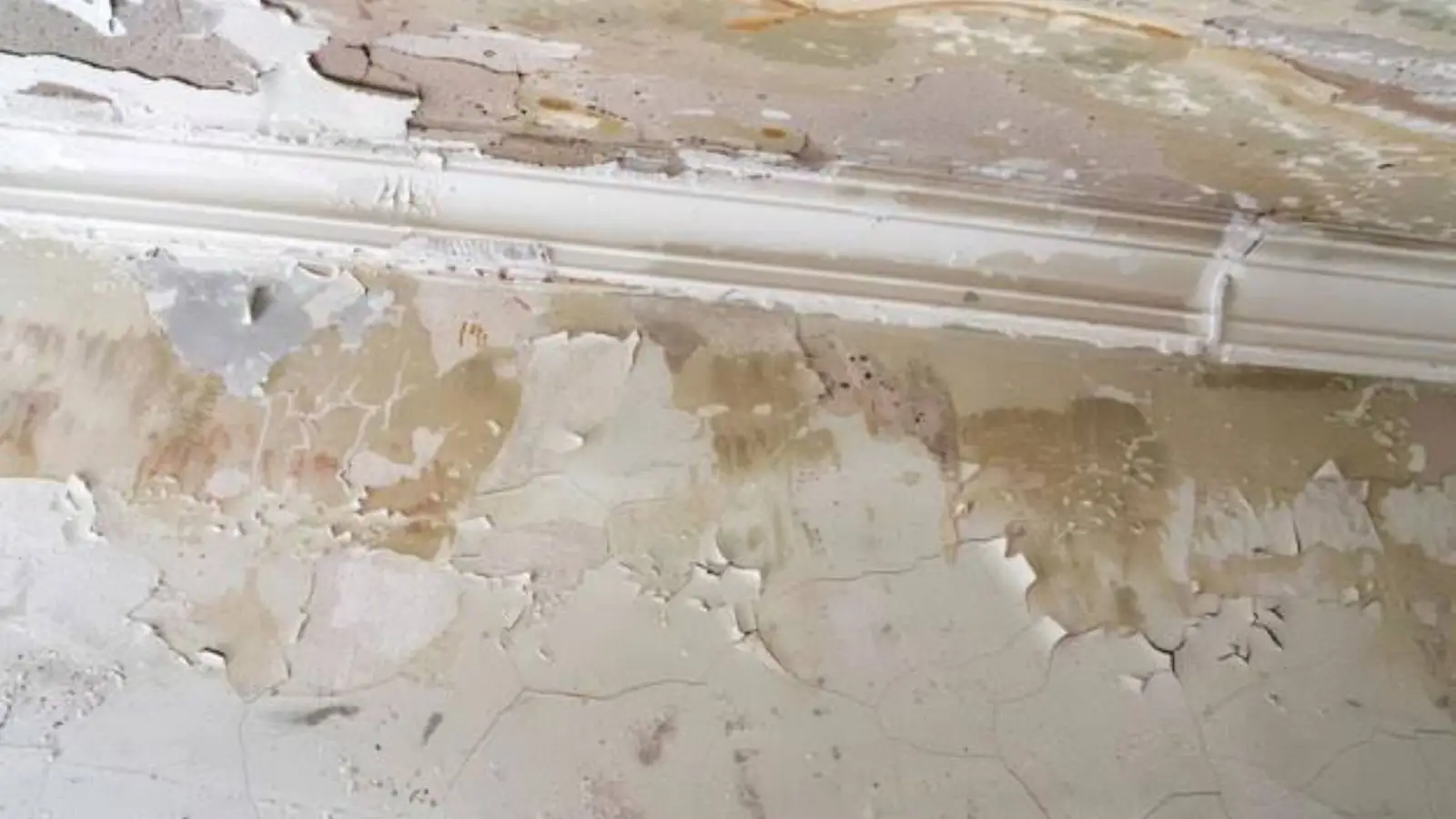
A stain, a soft spot or a hole: three different problems
Picture a bedroom wall with a tan ring that was not there last month. You press a thumb into the middle and it gives slightly, like a stale cracker. That small test tells you more than the color does.
A stain means water reached the surface and dried, or is still arriving slowly. A soft spot means the gypsum core has absorbed enough moisture to lose strength. A hole means the panel has failed or someone has already cut it open to look.
Each stage needs a different repair, and the stage also hints at timing. A dry stain with a firm wall may need only sealing and paint once the leak is fixed. A soft spot almost always means the panel comes out.
Whatever the stage, find the source first. Repairing a wall under an active leak just means doing the job twice.
Drywall, plaster and what sits behind them
Most walls in newer construction are gypsum drywall, and older homes may have plaster over lath. They react to water in different ways, which changes how the repair is planned.
| Wall type | What water does | Typical repair path |
|---|---|---|
| Gypsum drywall | Paper facing and core absorb water, then soften, stain and can grow mold if they stay damp. | Cut out wet sections, dry the cavity, replace the panel, tape, texture and paint. |
| Plaster over lath | Harder and slower to soak, but it can loosen from the lath and crumble at the edges. | Dry in place when it is sound. Patch or re-plaster failed areas. |
| Moisture-resistant board | Handles brief wetting better, but long exposure still ruins the core. | Assess with a moisture meter, then dry or replace. |
| Insulation in the cavity | Batts hold water against the framing and lose their value when wet. | Remove wet insulation, dry the framing, reinstall. |
The cavity matters as much as the surface. Wet insulation and damp framing stay wet long after the paint looks fine, which is why moisture readings beat visual checks.
Wall feels soft or the stain keeps growing? Call the 24/7 line, say where the water came from and we will talk through what to check.
☎ (760) 769-1159Drying before any patching
Patching a wall that is still damp traps moisture behind the new finish. Drying is the first stage of any wall repair, and it follows the same logic as water mitigation on a larger loss.
A technician maps moisture with a meter, opens the wall where readings stay high, and sets air movers and dehumidifiers to pull water out of the panel and the cavity. Small holes drilled low in the wall can let warm air circulate inside. Readings are repeated until framing and board return to a dry baseline.
This stage can take several days, and rushing it is the most common reason a patch fails. If a contractor wants to paint over a wall on day one, ask what the moisture readings say.
What the repair sequence looks like
- Find and fix the sourcePlumbing, roof flashing, a window leak or a condensate line each needs its own repair before the wall is closed.
- Remove what cannot be savedWet drywall and insulation are cut out past the damaged edge to sound material.
- Dry the cavity and framingEquipment runs until readings match a dry reference wall.
- Replace insulation and boardNew panels are hung to match thickness, with fasteners set to avoid the old damage.
- Tape, texture and primeJoints are finished and the texture is matched to the existing wall as closely as the surface allows.
- Paint the full wallPainting corner to corner avoids a visible patch outline.
Texture and paint are where a good repair becomes invisible or obvious. Ask whether the scope includes matching texture and painting the whole wall, because a small touch-up often shows under side light.
What drives the cost of a wall repair
Cost depends on a short list of variables, and none can be priced before someone sees the wall. The water category matters, since contaminated water adds removal and sanitizing work.
- How many square feet of wall are affected, and how high the water wicked up the panel.
- Whether insulation, baseboards, cabinets or electrical outlets are involved.
- How many drying days the equipment needs to reach a dry reading.
- Whether the wall has a special finish such as plaster, tile or wallpaper.
- The size of the finish work, including texture and paint on adjoining surfaces.
Want your real number? Expect a written scope, and expect someone to explain each line to you before the first panel comes off.
When a wall problem points to something larger
A stain on one wall sometimes belongs to a bigger event, such as a roof leak that traveled down a stud bay or a supply line that has been weeping for weeks. If you can see damage in more than one room, the wall repair belongs inside a wider plan, and water damage repair is the stage that rebuilds once drying is finished.
Homeowners in San Marcos and Solana Beach call with the same wall problems we see in Encinitas. In every case we recommend you shut off the source, photograph the wall before it is touched and keep any failed fittings for your insurer.
Electrical caution
If water has reached an outlet, a switch or a panel, stay away from the wall. Shut off power only from a panel that is dry and safe to reach. For any spark, buzzing or burning smell, phone 911 or the utility before you phone us.
Where the standards come in
Published standards guide this kind of work. ANSI/IICRC S500 covers professional water damage restoration, and the same body's S520 covers mold remediation. We cite them as the industry references, and we do not claim a certification beyond what we can show you on paper.
Encinitas note: permits and who to ask
The City of Encinitas Building Division sits in the Development Services Department at 505 S. Vulcan Ave, Encinitas, CA 92024. You can reach it at 760-633-2730 or building@encinitasca.gov.
Building permit applications are submitted online through the city's Customer Self Service portal. Which wall repairs need a permit is a question for the Building Division, so ask the Building Division whether your repair needs a permit before you open a wall. Making that call first spares you a surprise once the new drywall is already hung.
Frequently Asked Questions
Only after the source is fixed and the wall is confirmed dry. Paint can hide a stain while moisture stays trapped behind it, and a damp panel can soften or grow mold.
A soft, crumbling or bulging panel almost always comes out. A firm panel with a light stain can sometimes be dried in place if moisture readings return to normal.
Usually, yes. Wet batts hold water against the framing, so they are removed and the cavity is dried before new insulation goes in.
Ring the Building Division on 760-633-2730 or write to building@encinitasca.gov, and ask whether your repair needs a permit. Applications go through the city's online Customer Self Service portal.