
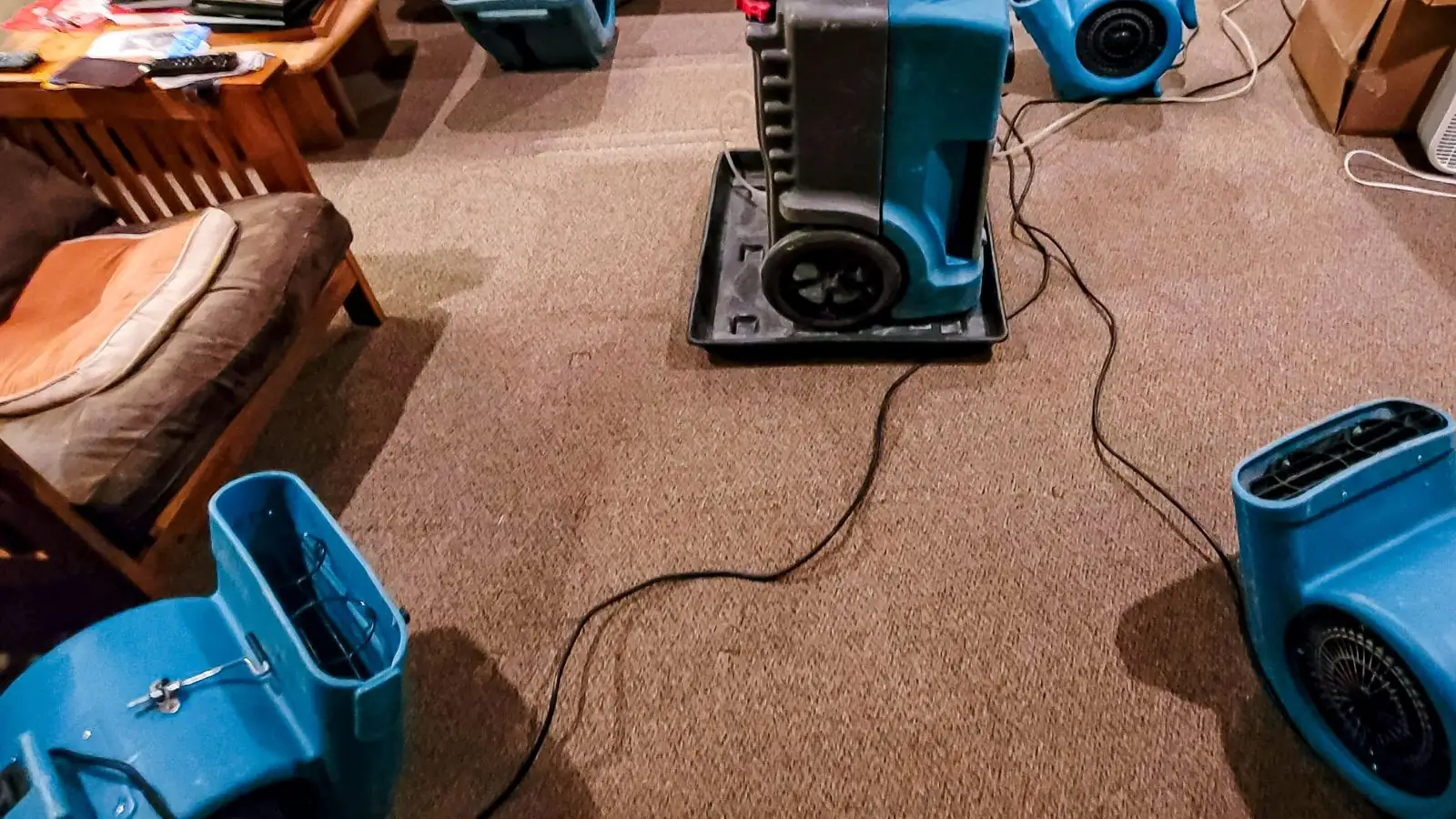
Carpet dries on the surface and stays wet underneath
Carpet is a thin top layer sitting on a thick, spongy pad, and the pad is what holds water. After a leak or storm intrusion, the surface fibers may feel nearly dry within a day while the pad underneath, and the subfloor below it, stay damp for much longer.
That hidden moisture is what mold uses. Growth needs moisture, organic material and time, and the backing, pad and dust in a carpeted room supply the other two. A floor that stays wet for a couple of days is a candidate for removal rather than hopeful drying.
You can check without tearing anything out. Press a dry paper towel firmly on the carpet for ten seconds and see if it picks up dampness, and use a moisture meter if you have access to one. Smell the room with the door closed for an hour, because a musty note is often the first sign.
Safety steps before you start
Before you clean anything, set up the space so you are not breathing or spreading what you disturb.
- Wear an N95 or better respirator, gloves and eye protection before touching affected material.
- Keep children, pets and anyone with breathing concerns out of the area.
- Do not dry-brush or sweep growth, since that spreads spores through the room.
- Do not mix bleach with ammonia or other cleaners.
- Stop and call a professional if growth covers a large area, returns after cleaning, or sits inside walls.
Musty carpet after a leak or storm? Talk to dispatch about what you are seeing and we will tell you what to check before anything gets pulled up.
☎ (760) 769-1159Carpet versus pad: two different answers
Carpet fibers can sometimes be cleaned and dried in place after a short wetting with clean water. Pad is usually different, because it is a foam or fiber cushion that cannot be cleaned inside and is inexpensive compared with the risk of leaving it wet.
That is why many restoration crews replace the pad even when the carpet survives. They can lift the carpet at a corner, remove the pad, dry the subfloor and stretch the carpet back down once everything tests dry.
Contaminated water changes the rule
Carpet that took in sewage or flood water from outside is generally not salvageable, because the water carries contaminants that cleaning does not reliably remove. Keep out of the wet area. If electricity or gas might be involved, call 911 or the utility first and a restoration company second.
What the smell and the spots are telling you
- A musty, earthy odor with no visible growth usually means a damp pad or subfloor.
- Dark speckling on the carpet backing, seen when you lift a corner, points to growth that has started.
- Discoloration along baseboards means moisture is climbing the wall as well.
- A sour smell can mean the water was not clean to begin with.
- A cold, clammy feel underfoot in one patch can mean a leak under the floor.
None of these tells you a diagnosis, and testing for mold is a separate question. What they tell you is that moisture lingered, and that the right response is to stop the source, dry the materials and remove what cannot be dried.
Odor control that actually works
Sprays and powders can cover a musty smell for a day, but they do nothing about the moisture producing it. If the pad and subfloor are still damp, the odor returns within days and sometimes smells worse.
Real odor control starts with removing the source material and drying the structure. Cleaning and deodorizing come last, once readings show the floor is dry, which is why the sequence matters more than the product.
Saved or removed: how most carpet jobs break down
| What happened | Typical outcome | Why |
|---|---|---|
| Clean water, dried within a day or so | Carpet often saved, pad often replaced | Short exposure, but pad holds water |
| Wet for several days | Carpet and pad usually removed | Growth and odor become likely |
| Sewage or outside flood water | Carpet and pad removed | Contaminated water cannot be cleaned out |
| Visible growth on the backing | Carpet and pad removed, area cleaned | Growth has reached the carpet itself |
| Musty smell with no visible water | Investigate for a hidden leak | Moisture is coming from somewhere |
Removal is not an overreaction when the facts line up. It is cheaper than a second repair after a subfloor has been rewet, and it lets the crew see what is below the floor.
What removal day looks like
- Protect the rest of the homeSeal doorways with plastic and keep fans from pushing dust to clean rooms.
- Cut and rollCarpet is cut into manageable strips, rolled and bagged. Pad follows.
- Inspect and clean the subfloorWood or concrete is checked with a moisture meter and cleaned.
- Dry the roomAir movers and dehumidifiers run until readings are back to normal.
- RebuildNew pad and carpet go in only after the subfloor reads dry.
When mold is involved, the industry's mold remediation reference is ANSI/IICRC S520, and you can ask whoever bids the job if their crews follow it. Our mold remediation page explains containment, cleaning and clearance steps in more detail.
After the floor is back
Remove the cause, not just the carpet. Fix the leak, redirect gutters, and ask a contractor about grading or drainage if rain keeps finding the same spot. Keep humidity steady and open the room to air movement.
Homes in Carlsbad and San Marcos face the same sequence after a soaked room, from stopping the water to rebuilding on dry subfloor. When the water came from storm runoff or rising ground water, our flood damage restoration page covers the drying and cleanup involved.
Encinitas note: Leucadia and rainwater flooding
According to the city's hazard plan, Leucadia has a chronic history of rainwater flooding, mainly near North Coast Highway 101 and North Vulcan Avenue. If you live near those streets, carpet on a ground floor is the first thing to inspect after a heavy storm.
After any storm that left water on the floor, check the pad and the tack strip at wall edges within a day or two, and photograph what you find. Water from outside is not clean water, so carpet that took it in is usually removed, not dried.
Frequently Asked Questions
There is no exact clock, because temperature, humidity and the water's source all matter. As a rule of thumb, carpet and pad that stay wet for a couple of days are at risk, and removal is more likely than drying.
Usually the opposite is better. Pad is the part that holds water and cannot be cleaned inside, so it is commonly replaced even when the carpet is saved.
Not by itself. Steam adds more moisture to a floor that may already be wet underneath, and it cannot reach the pad. It is a finishing step, not a substitute for drying and, where needed, removal.
A dehumidifier helps, but it cannot reach water trapped in pad and subfloor on its own. Professionals combine air movers, extraction and moisture readings to confirm dryness.
Any ground-floor carpet that takes in storm water is at risk. The city's hazard plan names Leucadia near North Coast Highway 101 and North Vulcan Avenue as a place with chronic rainwater flooding, so those addresses should inspect promptly after heavy rain.