
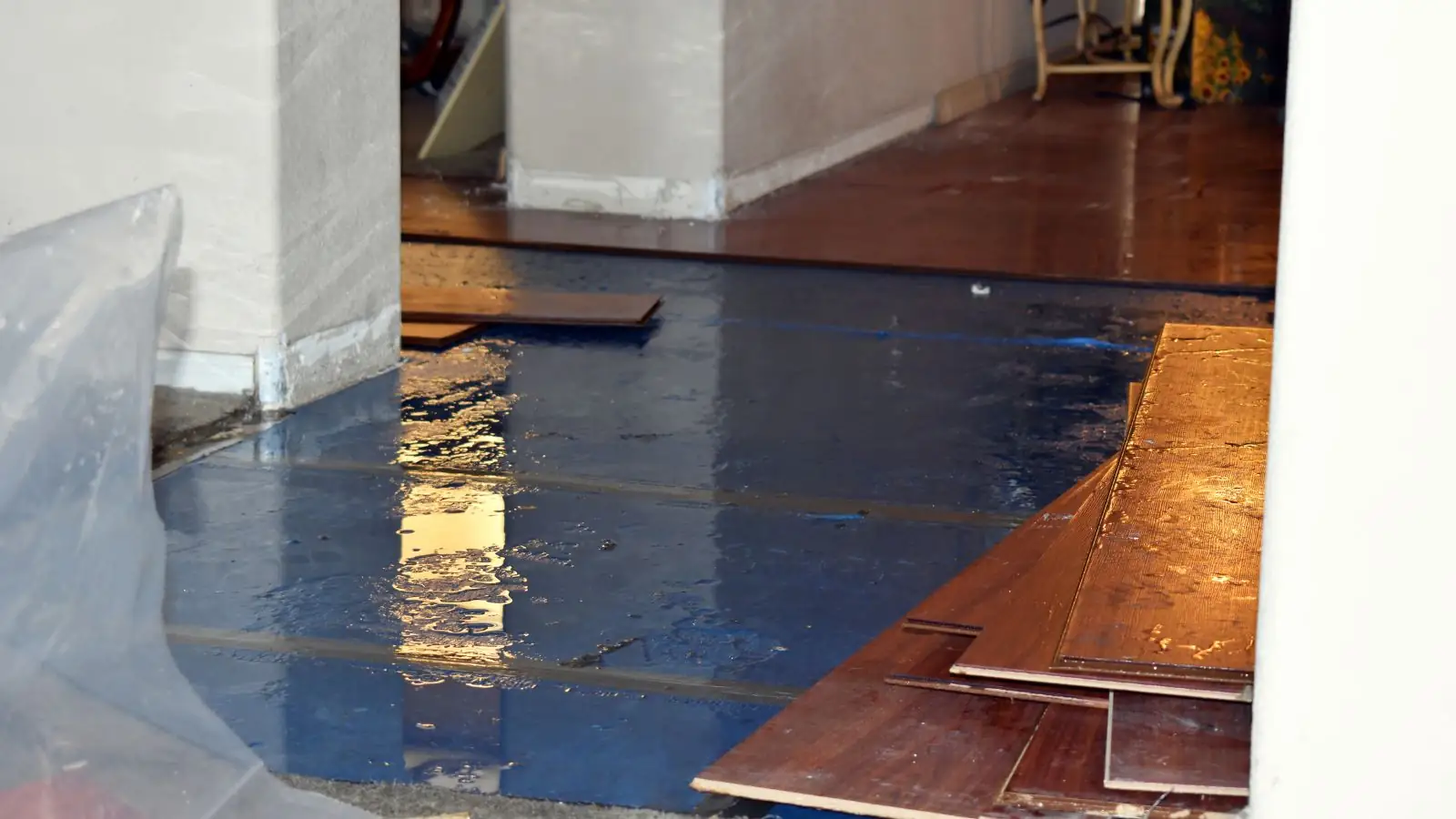
Why laminate fails faster than other floors
What is laminate actually made of? A photographic layer and a clear wear coat sit on top of a core of compressed wood fiber, and a backing layer sits underneath. The top is tough against surface spills, but the core swells when water reaches its edges.
That swelling is permanent in most products. Once the edges of a plank grow thicker, the click-lock seams push up and no amount of drying flattens them back down. The goal after a leak is to save as many planks as the damage allows and protect what is underneath.
Reading the damage from the seams
Walk the floor slowly in raking light from a window or a flashlight. The pattern tells you how far the water traveled.
- Raised, rounded seams between planks point to edge swelling from water at the joints.
- Peaking, where two planks rise into a tent shape, means the floor has expanded and has nowhere to go.
- Cupping or a bowl shape across a plank suggests moisture arriving from below the floor.
- A spongy or soft feel means water has reached the subfloor or underlayment.
- A musty odor, even without visible damage, means something below is still wet.
Color matters less than direction. Water that came from above leaves staining and swelling near walls and under fixtures, while water that rose from below tends to lift planks in broad, even patches across a room. Knowing which one you have narrows the search for the source and saves you from replacing a floor that will fail again.
Sound can help too. Tap along the floor with a knuckle. A dull thud in one area against a crisp tap elsewhere often marks trapped moisture.
Planks lifting or seams swelling after a leak? Ring dispatch, describe the room, and we will tell you what to do while you wait.
☎ (760) 769-1159Saved or replaced: a quick triage
| Situation | Typical result | Reason |
|---|---|---|
| Surface spill wiped within minutes | Floor is usually fine | Water never reached the core |
| Wet seams for a short time, no swelling yet | Often salvageable with fast drying | Core has not absorbed much |
| Swollen or peaked planks | Affected planks replaced | Swelling does not reverse |
| Water under the floor from an appliance leak | Floor lifted for drying, many planks lost | Underlayment and subfloor hold water |
| Wet for several days | Replace and dry subfloor | Growth and odor become likely |
Because click-lock laminate floats, a technician can sometimes lift planks in sequence, dry the subfloor and reinstall undamaged boards. That depends on the product and how long it stayed wet, so it is a judgment made on site with moisture readings.
The subfloor question
The visible floor is only half the job. Water spreads along the underlayment and into the subfloor, and a wet subfloor under dry-looking planks is what turns a small leak into a musty room a month later.
A moisture meter reading on the subfloor gives you a number to work from. Thermal imaging can show cool, wet zones without lifting anything, and it is how our water mitigation crews decide where to open the floor and where to leave it alone.
If the home sits on a slab, moisture can also rise from below. If the source is a slow pipe leak in the slab or a wall, the floor will keep failing until that leak is found, which is a plumbing call before it is a flooring call.
Drying and rebuilding step by step
- Stop the waterShut off the appliance supply or the main valve and mop up standing water.
- Pull furniture and area rugsWet rugs can hold water against the floor and stain it.
- Start air movementRun fans across the floor and a dehumidifier in the room with doors closed.
- Measure before decidingMoisture readings on planks and subfloor show whether anything is still wet.
- Replace what swelledMatch the product and run direction, and let the subfloor dry fully before new planks go down.
Replacing planks, trim and baseboard falls under our water damage repair work, and it goes best when drying is finished first. Ordering the work the other way sets you up for a second repair.
Check the bill, not just the floor
A hidden leak sometimes shows up as a jump on the water bill before anything shows on the floor. Shut off every fixture, check whether the meter dial still moves, and treat a moving dial as a sign of a leak somewhere between the meter and the house.
The same habit helps readers in Del Mar and San Marcos, where the first step is to check your own bill to see who reads your meter and whom to call about it.
Where the standards come in
Published standards guide this kind of work. ANSI/IICRC S500 covers professional water damage restoration, and the same body's S520 covers mold remediation. We cite them as the industry references, and we do not claim a certification beyond what we can show you on paper.
Encinitas note: which district reads your meter
The City of Encinitas says the San Dieguito Water District, run by its Utilities Department, serves Cardiff, Old Encinitas, Leucadia and part of New Encinitas. The city lists Olivenhain Municipal Water District as a partner agency but does not say which areas it serves.
To find the provider for your address, the city points people to its MyEncinitas map. Knowing who bills you matters when a floor goes bad, because a sudden jump in your usage is a reason to call the right office and look for a hidden leak.
Frequently Asked Questions
Yes. Matching dye lots and profiles years later is difficult, so spare planks from the original installation make a partial repair far easier and keep the floor looking uniform.
In most cases no. Once the fiberboard core has swollen, the edges stay thick and the seams stay raised. Drying still matters because it protects the subfloor and the planks that did not swell.
As fast as you can safely manage. Standing water at the seams is absorbed quickly, so mop it up, lift rugs and start air movement the same day if you can.
Not always. Click-lock floors can sometimes be lifted in sections and reinstalled, or the damaged planks can be swapped. It depends on how far water spread and how long the material stayed wet.
Yes. A slow supply line or slab leak can wet the subfloor for weeks. Cupping, a musty smell or a sudden rise in your water usage are all reasons to check.
Check the bill you receive or use the city's MyEncinitas map. The city says San Dieguito Water District serves Cardiff, Old Encinitas, Leucadia and part of New Encinitas, so some addresses may use another provider.